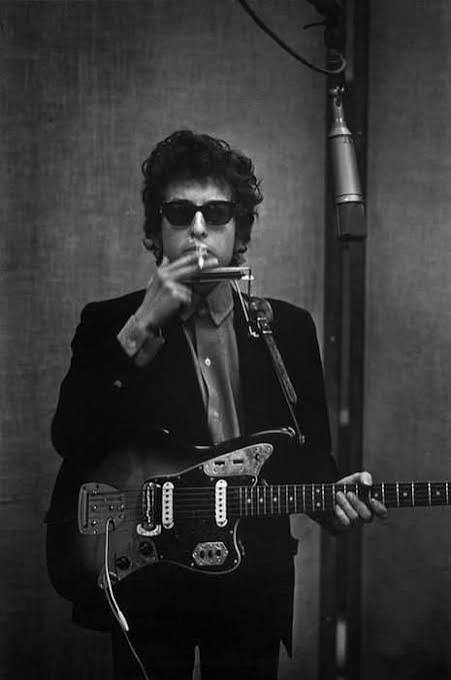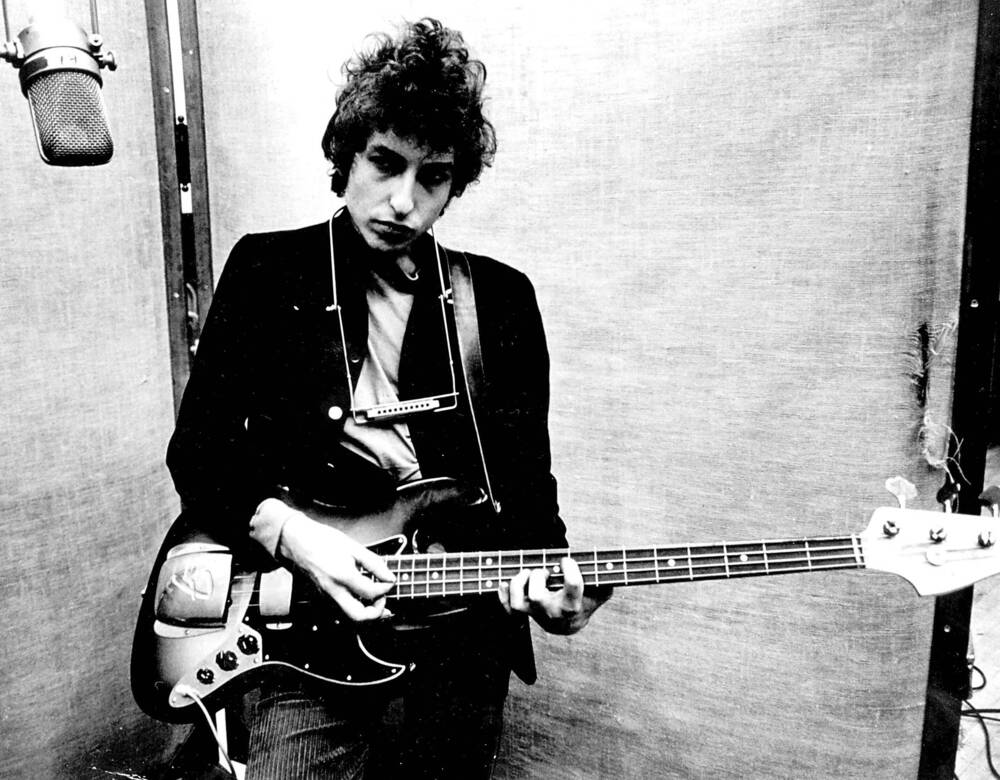
Studio Album | Released Spring 1965 | Recorded in January 1965 at Columbia 7th Ave, New York City | Columbia Records | Produced by Tom Wilson
If you were around in 1965, which I wasn’t, and you witnessed the release of this album and had a stake in the opinion pool on the life and work of Bob Dylan, you’d have been thrust into one of two viewpoints. You could have thought that Bob Dylan sold out. You could also have thought that he bought in. All I think, as a person born much later than 1965, is that Bringing It All Back Home is one of Bob’s greatest albums, one of the best albums ever released, and contains songs that are extremely dear to my heart, connected to life events that hold high sentimentality. That makes it one of my all time favorite albums of the 60s.
1965 would turn out to be a peak year for Dylan, with the release of this record and its follow up, Highway 61 Revisited. Both albums changed rock and roll and initiated shifts in how people thought about the power of music, specifically rock music geared toward a new generation. In the leadup to this record, 1964 was happening. As that year was ending, Bob was on a fall tour, starting to come to grips with his fame and internally reckoning with what he was supposed to be doing with his music. It had become old for him to go up on stage with a guitar and harmonica and sing. The new wave of music was rock. The Beatles were starting to emerge and shift things in a more creative direction. Bob’s output in song energy had to change. His path from the monochrome and bleak The Times They Are A-Changin’ to more colorful music, powered by electricity, was building as 1964 closed.
“My words are pictures, and the rock’s gonna help me flesh out the colors of the pictures.”
How electricity and its use in rock became the new thing for Dylan came from several routes. He made it into the orbit of Mike Bloomfield of the Paul Butterfield Blues Band, a group pushing the then boundaries of blues infused rock. Bob also made the acquaintance of a group known as the Hawks, a Canadian band backing Ronnie Hawkins. As it would have it, the Hawks would eventually become Bob’s backing band and later grow into their own group, known only as The Band. Also, interesting enough, and a classic jam then and still, The Animals covered “The House of the Rising Sun,” an electrified, real moving version of the folk original.
On Halloween 1964, Dylan played a show at Philharmonic Hall in New York and performed three new songs as a taste of things to come: “Mr. Tambourine Man,” “Gates of Eden,” and “It’s Alright, Ma.” This was new material, unlike anything he’d put down before, full of surreal imagery, existentialism, and anti-authoritarianism. Dylan’s songs had taken plenty of jabs at the man before, but with this new record his poetic mind was in deep expansion. The poetic influence was growing and definitely starting to show. The statues of Pete Seeger and Woody Guthrie were getting spray painted with the symbolism of Rimbaud and Baudelaire. All to a rocking beat.
“I don’t call myself a poet because I don’t like the word. I’m a trapeze artist.”
Recording took place on January 14 and 15, 1965. Dylan was definitely in the lead on the arrangements. He had a full backing band behind him and instructed each of the members on what he wanted until everything came together. He was a painter with a paintbrush, to paraphrase Daniel Kramer. Most of the tracks were done in only a few takes, and three of them, “Mr. Tambourine Man,” “It’s Alright, Ma,” and “Gates of Eden,” were done in one long take, without stops.
The Object
My copy has been nestled safely on the shelves alongside some of Bob’s other albums since March 2025. It’s not a particularly expensive record. It’s a 1972 Columbia reissue from their Terre Haute plant, bought on Discogs. Sound quality: great. I like the early 70s reissues of late 60s rock records. To me they’re a cheaper alternative to going for something super pricey. It’s an honest copy, and it has suited me well.
Strange enough, the songs on this record have been with me for many years. I had been deeply aware of this record’s greatness long before I had a chance to get a copy. That’s the beauty of vinyl for me. Once you finally get a record you’ve loved for years on vinyl, you’re truly acquainted with it. It’s like meeting someone for the first time who you’ve only ever spoken to on the phone.
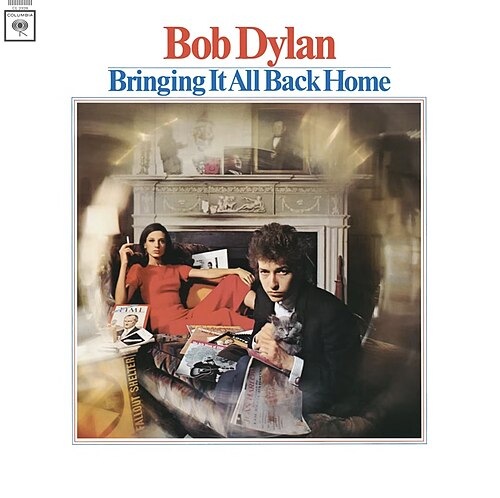
Bob envisioned a cover photo vastly different from anything he’d wanted prior. The cover appears like a mosaic, or a mirage on a hill, or a collage of psychedelic imagery. And there’s a cat. The beautiful woman is Sally Grossman, wife of Albert Grossman. Bob’s previous album, Another Side of Bob Dylan, appears in the back of the shot, surreptitiously placed near the large fireplace. Other seemingly random pieces of imagery, LPs, and miscellaneous ephemera appear throughout. The kitten Bob is holding was his pet at the time, named Rolling Stone. The other two characters in the photo, Bob and Sally, give off that feline air themselves, that lounging chillness paired with intensity that cats possess. The rear cover contains several photos from Daniel Kramer of the artist in various situations, people surrounding him, Joan Baez and Allen Ginsberg among them. There are also musings from Bob published that year, writing that would make up a piece of his book Tarantula, published later. It’s a nice package of surrealism from Bob. One of the all time great record cover photos.
A Word on Dont Look Back
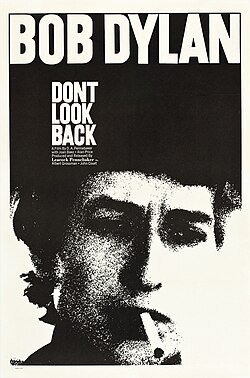
Before getting into the music, the companion piece to this record deserves its own mention. D. A. Pennebaker’s Dont Look Back captures Bob touring England in the spring of 1965, in that strange pocket of time when this record wasn’t out yet. You can hear test pressings playing in the background of hotel rooms. The film was Albert Grossman’s idea, and Pennebaker himself didn’t know much about Dylan going in, which might be why it works. There’s no reverence in the camera, just observation. What came out of it is one of the first great rock documentaries, and the alleyway cue card sequence for “Subterranean Homesick Blues,” with cards lettered the night before by Bob, Bob Neuwirth, Joan Baez, and Donovan, is arguably the first music video. The film also catches the critics of the day dismissing Bob’s new output as bad poetry, which tells you everything about how far ahead of the room he was.
My favorite moment is the hotel room rendition of “It’s All Over Now, Baby Blue,” right after Donovan plays his song. Bob one ups him, but there’s no malice in it. It’s sincere, and you can just see his greatness in that scene. If you own this LP, the Criterion release of Dont Look Back is the companion physical media to it. The record and the film are two halves of the same moment, and having both on the shelf feels like the complete picture of Bob in 1965.
The Music
Side 1 is the electric side.
Subterranean Homesick Blues
Recorded in one take on January 14, 1965.
This would turn out to be a huge song for Bob. It was his first exploration into electric rock music, and it was his first single to chart in the U.S. It was also accompanied by a pop art video, seen in the documentary Dont Look Back by D. A. Pennebaker. That doc is seminal in its own right as one of the first rock docs. Dylan’s cue card moves along with the lyrics were cutting edge music and film combined at the time. You could call that little segment one of the first ever music videos.
It’s a pretty simple song as far as the structure of the lyrics goes. It has a repetitive nature to it, and with that severe twanging guitar, hearing this for the first time in the 60s must have been a blow to the head. The lyrics come at you quick. It’s beat poetry, essentially. Every line is a couplet, and each allusion can be taken as anti government, anti establishment, or simply a slogan for the general beat vibe and culture of the era.
The opening couplet, by today’s rationale, is museum quality art. A perfect encapsulation of not only Bob’s life at the time, but the entire zeitgeist of the mid 60s. Something’s cooking below, while the people are out in the open, questioning the man and his purposes. And his decision making.
Johnny’s in the basement
Mixing up the medicine
I’m on the pavement
Thinking about the government.
Several warnings to the “kid” appear throughout the song. Possibly Bob’s words were intended toward himself, or his own life. What you can read into those warnings is that there’s grace in giving up, but be careful while you do it. There’s a sense of giving in here, to me. In all of this whirlwind of getting by, all we can really do is get by and try to get our kicks while we can. The idea that there’s something that can be done is starting to fade away from Bob’s protest songs. What’s replacing it is an amplified guitar, a general disdain toward the square community, and the idea that art is king. And rock is art.
Inspiration for how this song sounds, and for its title, was either stated explicitly by Bob or alluded to. Dylan said the song came from Chuck Berry, a little “Too Much Monkey Business,” and other scat songs of the 1940s. The title is speculated to have come from a Jack Kerouac novella, The Subterraneans.
She Belongs to Me
Recorded January 14, 1965.
This song is one of my favorite love songs of Bob’s career, unlike the love songs he’d put out up to this point in both sound and demeanor. The electric guitar and rhythm section add the shades of calmness and depth that the words rely on. With the sound of this song, you can start to see the direction Bob was going with his calmer love tunes. This song and “Love Minus Zero” were a sign of things to come, well before the almighty brilliance of Blood on the Tracks.
But with this song we still need to consider who it’s written for. At this time, Joan Baez and Bob were still well within each other’s orbit, each jabbing the other with words of steel along their life paths. By this point Bob was obviously headed in one direction and Joan in another. It could also have been written about Suze Rotolo, whose relationship with Bob was beginning to fizzle out. New flames had emerged elsewhere. The figurehead, whoever manifested her in Bob’s physical life, is given reverence as a stunning character in both mind and shape. And with the gracious acceptance of the narrator, she belongs to him.
The title itself brings into question whether this is even a person. Could it be a place, a town, a country? Ask many and they’d say that one person can’t belong to another. The narrator asks the listener to bow down to her on Sundays. Could this be a religion or a religious figure? It may refer to all of the women in Bob’s life at that time, or it may refer to his muse herself. Unable to sustain, unable to satisfy, but well maintained and kept away.
I love the swaying gentleness with which the lyrics come over you. The simplistic structure gives it that soft feeling. Definitely not a mean sounding song. Even as Bob is tearing eardrums on the song before and the one after, he’s offered us a walk down a pleasant path as he displays some of the feminine inspirations in his life.
Maggie’s Farm
Recorded January 15, 1965.
Following the delightful love song prior is another absolute rocking banger of a track. Five verses of heavy steel rock and roll, right out of the factory. Fast and loose. Story has it that this was the final song recorded for the record, and it only took one take, again. They more than likely blistered through it, but what appears is an adept band version of a loose blues rock song.
This one is central to the legend of the 1965 Newport Folk Festival. The energy and attitude of this song were a perfect match for the energy, attitude, and lack of thought in the decision making of Bob and his band as they essentially crashed the festival with a short electric set. Entire books have been written about that event and its context, and the Timothée Chalamet vehicle A Complete Unknown benefits a lot from that moment of cultural change as its source material. The powers that be, the ones involved, may claim that negative reactions to the amplified instruments weren’t the impetus for the semi riot that occurred. Some folks were probably just upset at how loud it was compared to everything else. If you’ve surrounded yourself with soft spoken, nice folk music, sung by nice, put together dandies and delicate women, and then you hear the headliner lash out a guitar riff like the one starting this song, well. It would be like Cat Stevens opening up for Black Sabbath.
The subject matter across the five verses is representative of anti labor, anti government, and anti establishment mechanisms. The power is in the people who refuse to fall in line. Over and over there are references to the life of the laborer in this track. Some place Bob himself in the narrative, finding issue with and going against his record company executives. Easy to interpret it that way, as he was currently doing just that by recording this music.
In the first verse, the worker’s mental state is explicit. There are ideas in his own mind that are driving him insane. The work is getting to him. It’s incessant.
The second verse brings in the hypocritical and unrepentant nature of hard labor. A nickel is given, a dime is given. A fine is given for every minor infraction. You’re stuck.
The third verse brings the government into the mix. Maggie’s pa is the one putting out a cigar on your face just for fun, and the National Guard has posted up around his door. The White House.
The real puppet master of the whole operation is behind the fourth verse. The ma fills the servants’ brains with information about man, God, and law. Useless drivel, words and rules and faith to keep them in line. And meanwhile she lies about her age. Hypocrisy.
The final verse sounds the most sincerely like it comes from Bob’s own mind, a declaration that he’ll keep doing his best to be exactly who he is, no matter how badly everybody else wants him to be just like them. A perfect line for the Newport crowd.
Love Minus Zero/No Limit
Another sweet and calm love song, one that sort of builds off the concept of “She Belongs to Me.” Bob is still deep in poetic land, describing a love he has. What happens in this song is that a figure of affection is placed in a context. It’s like he has a person, likely a woman, in mind, and he’s building the beautiful painting around her. If you sit and let the words wash over you, Bob Dylan’s songs can appear like images, or abstract or surrealist art. Good poetry does that, and with each listen you hear or can visualize something new. That’s where I get the most enjoyment out of Bob, coming back to his songs over and over. There’s always a little new swash of color that gets added each time I hear a song like this one. A little more clarity. A new line takes it out of me each time.
I love the closing image of the raven with a broken wing, tapping at his window. To me this metaphor represents an entity like a weak omen. A dark test, but with a vulnerability. Any romantic can see within this line women of questionable intent, or the tests they can put men through. But remember, they are all vulnerable, and they need your security.
This song is connected to the Dont Look Back documentary. The subject of the song is most often thought to be Sara Lownds, a model who Bob had become involved with and would marry in late 1965. Sara was a friend of Sally Grossman, who appears on the cover of the record, and Sara was the one who introduced Bob to D. A. Pennebaker.
There are zen like qualities addressed here. As if there’s goodness and evilness all around the figure, yet nothing bothers her. It’s also been interpreted that the love figure is his muse, a constant source of disillusionment. Success versus failure.
Outlaw Blues
Recorded January 14, 1965.
This is a raw, chugging blues jam. Less imagery and less complexity than the other material here. It refers to the outlaw Jesse James and Robert Ford, his killer. Bob’s the one hanging the picture frame, which was the setting and circumstance of the legendary outlaw’s death. Here Bob is expressing his standoffishness and his vulnerability to the press, and to the fame of his moment.
For the electric side of this great record, this may be the most energetic blues tune Bob had done up to this point. This song and the next come at you quick, and if you listen intently, you won’t miss the meaning from the good songwriter here.
On the Road Again
Recorded January 15, 1965.
A seemingly simple blues track. It starts with a cliche, waking up in the morning, but devolves into obscure references and images. Blues deconstructed. Musically it’s great and rollicking. Lyrically it’s a tad dense, but typical of Bob’s writing during the time. A transient Bob, reflecting on the in-laws and their odd, over demanding ways.
Along with other songs on the album, this one addresses Bob’s reluctance to fit in with normal society. He’s putting a mirror up against it, conflicting with it, and describing it, warts and all.
Bob Dylan’s 115th Dream
Recorded January 14, 1965. Intro recorded on the 13th.
The track starts with a false start and a burst of laughter from Bob and those in the studio. A fitting intro to this track, the final one on side 1, and the longest and most sprawling on that side. It covers plenty of ground in its eleven verses. A self contained dreamscape, apparently covering the discovery of America. I think it’s a distillation of the whimsy inside Bob’s mind about his place in the United States. Every artist around this time, and probably since, along with most good Americans, goes through their own self discovery of America.
Side 2
Side 2 is mostly solo acoustic, and the first three songs were done in one take. Side 2 of Bringing It All Back Home is incredible. It’s hard to describe just how good it is. To me it’s Bob’s greatest side of close to any record he made, definitely of the 60s. These songs touch on a brilliance that few songwriters have known. It’s top tier stuff and it blows me away every time I spin the record on my turntable.
All songs from side 2 were recorded on January 15, 1965.
Mr. Tambourine Man
The stuff of greatness. You have to give it up to the beauty of this song, and to Bob’s conviction in writing and singing it.
The Mr. Tambourine Man of this song is most often cited as being inspired by Bruce Langhorne, guitarist and recording session mate of Bob’s. He used to sport an oversized, specialty drum type instrument that sounded like a tambourine when played. As the lead figure of the song, the title alone gives it a playful whimsy, and the song provides a counterpoint to the heavy rock numbers of the first side. It fits perfectly here as the first song of side 2.
In line with similar interpretations of some of the other songs on this album, I’ll subscribe to this song being a sort of request from the artist to his muse for inspiration. If that rings true, then the entire album can be read as some sort of hangover come down, a snap into reality, a snap into the music world Bob wanted to inhabit. If you look at him in this time period, he’s mostly performing, writing, or out seeking inspiration. Whoever the Mr. Tambourine Man is, he brings artistic or spiritual salvation. He’s coaxing Bob into the habits of the greats, the shelter required of the famous. The sweet ship destined for the promised land. Eden comes after that.
The melody and tone of the song have such a strong connection for me to some sort of adolescent emotional state. This may be one of the first songs I can reference in my coming online to appreciate music. It’s one of those songs that most of us will hear, or definitely should hear given the direction of today’s music, as early as possible in our lives. It’s a functional song, severely inspiring me to look for more music that either sounded this way or made me feel the emotions it did.
Some reports say this song was written after a hazy, hungover experience post Mardi Gras in New Orleans. You can feel that psychedelic atmosphere running throughout the lyrics. There are fantastical elements to the words in some instances. Things don’t make sense, and there are strange time references. What is a jingle jangle morning, exactly? This song is a mental state, a fairy tale. It’s undeniably unique in the feelings it evokes. For me it can’t be taken word for word, or at face value. It weaves images together. Like others among Bob’s best songs, they occur like pastiches, conjured up images of broken promises, fluttering wavelike across the ether of Bob’s odd creativity.
If we’re comparing this version with others, it’s this version for me. The Byrds took a great song and made their own precise reworking of it, and it skyrocketed Bob, The Byrds, and the song itself into the stratosphere of popularity. The Byrds version is amazing too, but I’m a sucker for some of the lines that only Bob’s version includes. For me this song is about the words, and the images those words make in my mind. There’s no imitating that style when it came to Bob. Maybe Joni Mitchell came the closest.
One of my all time favorite songs. Every time I hear it I feel safe, like it’s playing just for me. There’s one line in the later verses [insert lyric here] that gets me every time. Those words strung together, sung in Bob’s signature voice, mixed with a simple acoustic guitar. Brilliant. A highlight of this year of music.
Gates of Eden
“Gates of Eden,” following “Mr. Tambourine Man,” is another song full of dream and surreal imagery. It’s Salvador Dali and William Burroughs together. The Eden of this song is not the paradise most would imagine. Each verse builds images, each line and each couplet building imagery together. Imagery that is meant to warn, to strike fear or woe.
The song was released as the b side to the “Like a Rolling Stone” single after the release of this record. A lengthy, weighty single that one is. Two epic songs, each in their own way.
Here Bob spins one of his all time most surreal songs, which some have compared to the poetry of William Blake. If this song fits into some sort of narrative timeline along Bob’s output, it would be a great sequel to “The Times They Are A-Changin’.” That song warns of what is coming. This song explains what’s here, now that we’re in it. There are many images produced in the lines of this song, and grasping at all of them beckons multiple themes to emerge. Overall, there is a reluctant religious faith in the undertones of this description of an Eden. Behind the gates of this so called Eden, this paradise, is not the paradise you’d likely think.
The activities, or the wordplay implying some sort of action from the characters behind the gates, are all harsh and scary. There is a savage soldier. There is Aladdin. There is a black madonna riding a chrome motorcycle. It’s all some sort of artistic joke to call this Eden. Its title should be Sodom, or Gomorrah.
The final verse hints at the imagination of this whole experience. At dawn the narrator’s lover comes to describe the dream of what’s occurred before. There are no attempts to dig into what each piece of it means. There’s no way to describe what’s been dreamt. There are no words to identify what was true. If there were any truth, it would be outside these gates, but Bob reassures us, or rather leaves us haunted, with the final line: there are no truths outside the gates of Eden.
It’s Alright, Ma (I’m Only Bleeding)
By this point in side 2, nearly at the end of the record, your brain should be melting from the roller coaster of words you’ve just experienced, and from the beauty of simply taking these songs in. If you hadn’t had enough, this song comes and nails the top of your coffin closed.
His most epic acoustic work up to this point, this song is one of Bob’s masterpieces, on a record that was itself one of his masterpieces.
Just like the songs before it, this one creates more harsh imagery, and it also serves as a spiritual sequel to some of his earlier music. He’s an artist putting the past behind him, commanding American society especially to witness the shitty situation it was in. This was on the eve of all out war in Vietnam, a very heady time, 1965. Not yet full on protests in the streets and blood running into the gutters, but things were heading there. Many thought of Bob as the wizard, the harbinger who predicted all of it with his music. The song offers no hint of a solution. He’s just the messenger, describing the scene.
Many of the scenes poke at the woes of capitalism and the fakeness and greed it produces:
Children’s toys provide distraction rather than purpose.
The song’s most famous line lays out a stark choice between constant renewal and slow decay. Cast off any sense of the old and get with the new, or fade out.
Another line takes aim at hatred itself. The self proclaimed virtuous forget that real action is more effective at making change than pure hate.
It continues as such. Each short verse, and each semi verse in between, bludgeons the listener’s mind over and over. Bob’s ability to fit maximum meaning into such short lines is present here, maybe more than in any of his other songs.
I must mention that this song will always remind me of The Sopranos, and the final episode of that show. I won’t spoil it for anyone, but I’ll say this. The lyrics of this song, and its placement in that episode, do more than reveal what happens at the end. To me there is no question. This song gets rid of all that ambiguity. For others, it might add to it. But there are lines that reference Tony’s fate. It’s also probably the best use of Bob’s music in any TV show, possibly any movie as well.
It’s All Over Now, Baby Blue
Though this song comes at the end of the record, it’s not to be overlooked. To me it’s a perfect ending song. It sums up not only the record itself, but Bob’s thoughts on the music business, his place in it, and possibly one or more of his current relationships. Suze or Joan, or both.
Bob seems to be in a different vocal register here when he’s reaching in the first part of a verse. In the second part of the verse he calms you down and makes it reassuring. In the first part it’s tense. Another great part of this song is the bass, providing a very subtle foundation that carries the weight of the lyrics so well.
There’s been plenty of speculation over the years about who Bob is supposedly singing this song to or for. To me it’s not that important, but I’d again have to assume it was self directed. This time period was about change for Bob, and one of the things that initiates change is letting go. How do we accept the new without getting rid of the old? Things are always in a state of flux. There’s the past referenced, and then there’s the shift.
Carpets moving out from under you: I picture movers taking old furniture out of a house while the person is still in it.
There is a passage in this song that makes it one of my all time favorites, and for me it carries enormous emotional weight. I’m a person who has moved around a lot and changed what I’m doing several times. I’ve pursued different things and different career paths. I feel like I’m always thinking about my past self. The final verse:
Leave your stepping stones behind, there something calls for you
Forget the dead you’ve left, they will not follow you
The vagabond who’s rapping at your door
Is standing in the clothes that you once wore
Strike another match, go start anew
And it’s all over now, Baby Blue
Those words I’ve carried with me for most of my adult life. It’s not okay to focus too hard on our past selves, the people we’ve come across in our lives, or the dead. In order to keep progressing, to keep going, we have to accept that all of those people, things, and places don’t have anything left for us. That past self, the one you’ve left behind, will undoubtedly come and knock on your door. It’s best to leave the door shut.
The song has been covered by many artists and has lived a life beyond what Bob probably imagined for it. To my ears, the 13th Floor Elevators version is one of the best covers.
Closing
Bob’s transitional masterpiece. It’s a statement piece for Bob’s place in history. Even though it feels at times rushed and put together intuitively, the record’s purpose shines through. It’s a jab at old lovers, at society, at intellectualism. It feels smart and wiseass at the same time. It’s incredibly prophetic and dismal, but also sweet and beautiful and just plain raw. Dylan had brought together a great team of musicians to get what he needed done for the tracks on the first side, but he was often not the leader that band needed. You can feel those musicians sometimes trying to keep up on the recordings.
For me it’s a close tie at #1 favorite Bob album, with Blood on the Tracks taking the other tie spot. Of course, the album that gets all the praise is his next one. I won’t stop short of giving that one all its due. But it’s Bringing It All Back Home where Bob was in flux. I think it’s some of his best work. It’s close to me emotionally in a few different ways. If you’re someone on the fringe, it makes sense. It always sounds new, every time I listen to it. It’s a record everyone should own. It’s one I’ll always own.