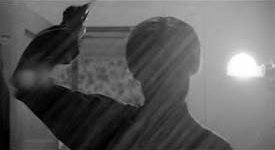
Film Score | Film Released June 16th, 1960 in New York City
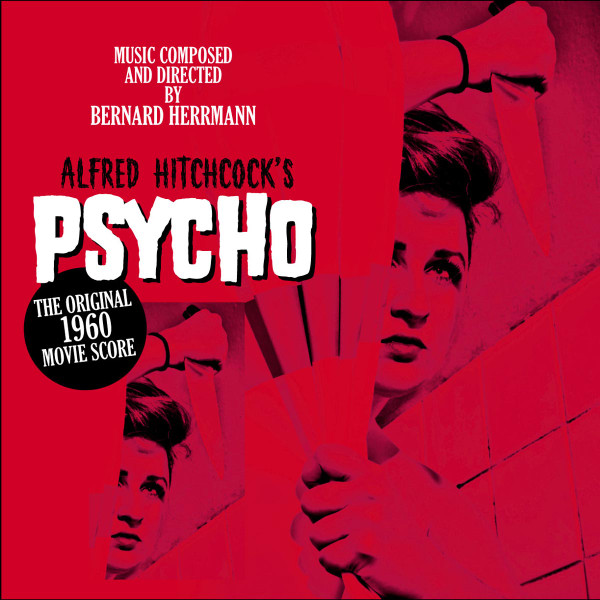
Bernard Herrmanns 5th film score as a collaborator with Alfred Hitchcock
Vinyl Passion | 2015 | Netherlands
Bought: Siren Records, Seaside CA | Sometime in 2016
The Object
Film music has a mysterious appeal to me, and especially in horror and suspense. It’s the genre where the finest blend of sound and image happens — full immersion, no separation between what you see and what you feel. And the history of a film is sometimes subverted entirely by the history of its score. That’s what happened with Psycho.
My first time watching it was probably in high school, early 2000s. I knew it carried a legacy even then, but I wasn’t fully aware yet of the cultural weight of the film or of what that soundtrack had done to modern consciousness. What I remember most distinctly is the staircase scene. The dread of it. That’s no small feat when the era I was growing up in was defined by slashers and gore fests going for full shock and awe. Psycho operates on a completely different frequency. It doesn’t shock you. It unsettles you. It did that to audiences in 1960, and it still does it today. That’s the mark of a real work of art.
There’s something I’ve always loved about film soundtracks on vinyl. In some ways the film score has become society’s classical music — people are increasingly drawn to film and video game scores as a way to fill a room, to musically enhance a workspace, to just live inside a sound. There are soundtracks out there that function completely as standalone albums. The movie experience deepens with repeated listenings of the score away from the film. You start to hear things differently. The music stops being illustration and starts being its own object.
Psycho is the horror film that started a lot of people’s relationship with the genre. Everyone has a scene they go back to when they recall their first time watching it. For me it’s the staircase. For most people it’s the shower. But for the full package of this film, there is no separating it from its score. The shrieking strings, the gleam of the knife blade, the staggering suspense of that shower scene — image and sound put together to create something neither could be alone. Bernard Herrmann’s uncanny instinct for sonic suggestion and his close working relationship with Hitchcock made it possible. Hitchcock famously said 33% of the effect of Psycho was due to the music. That feels like an understatement.
My copy is a European import pressing, acquired sometime in 2016 — most likely from Siren Records in Seaside, California. The pressing itself does the score justice: good depth, strong highs, which this music demands. The cover is another story. It doesn’t capture the film at all — the scene depicted, the figure shown, looks like a poor recreation rather than anything from the actual movie. But it has the right ingredients on the packaging: the title in that jagged lettering, Alfred Hitchcock’s name, the bright red scene, the knife in a hand, the words Original 1960 Movie Score. That was enough to pull it off the shelf.
Psycho is one of those films that stays with you long after you’ve watched it, and for me that staying power lives in this score. It’s gripping completely on its own, without the screen. You put this on in a room and something shifts. You visualize that something bad is happening, or has happened, or is about to. The music does that work without any images at all.
“The Knife” has to be one of the most recognizable cues in film history — second only, maybe, to the two-note announcement of the shark from Jaws. Parodied and referenced below in the Simpsons, one of my favorite callbacks. We’re talking genuinely iconic sound imagery, burned into the cultural subconscious. But that cue is only about thirty seconds of this score. There’s an entire architecture around it that most people have never sat down and listened to. That’s what this record is for.
The Music
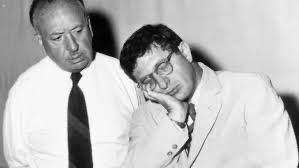
Bernard Herrmann was born in 1911 in New York City to German Jewish immigrant parents. He was the oldest of his siblings and grew up in a household steeped in arts and culture — the kind of environment that produces serious people. He developed an early fascination with classical composers and received his musical education at some of the finest schools in the city before landing at CBS Radio, where as a young man he was composing and conducting live orchestral broadcasts. It was there that he fell into a close working relationship with Orson Welles, scoring several of Welles’s radio productions before following him into film. Citizen Kane was his first score. The trajectory from there was steep and fast.
It was his collaboration with Hitchcock, however, where Herrmann’s masterpieces were made. Psycho was Hitchcock’s fiftieth film and their fifth collaboration together. For it, Hitchcock initially wanted something light — a bit of jazz, unobtrusive, background texture. Herrmann had other ideas.
The story of how this score came to be is almost as dramatic as the film itself. Hitchcock screened the first cut of Psycho and fell into a depression, convinced the film would fail. He considered shelving it entirely. Out of that uncertainty came a fateful creative decision — or rather, an absence of one: Hitchcock decided certain scenes, most notably the shower, should carry no music at all. Just the screams and the sound of the knife and the water.
Herrmann disagreed. He went off on his own during a holiday break in Hitchcock’s schedule and scored the film his way — including the shower scene. When he played it back for the director, Hitchcock’s response was immediate. He kept everything.
What made the execution possible was one audacious decision: strings only. No brass, no woodwinds, no percussion. A fifty-piece string orchestra and nothing else. The reasons why this worked go deeper than budget:
Strings carry a dynamic range that other orchestral families can’t match — they can whisper and they can shriek, and they can move between those two states faster than the human nervous system can process. Herrmann used pizzicato (plucking), tremolando (rapid bow movement to create trembling), harmonics, and sul ponticello — playing near the bridge to produce a harsher, more abrasive sound. He also employed con sordini, mutes placed across the bridge, to create what one scholar called a dark, unexpected tone entirely appropriate for the film. And critically, the all-string palette complemented the black-and-white cinematography — Herrmann himself called it a “black and white sound.”
But the deeper reason strings worked here is dissonance. The film is about mental disorder, a fractured psyche, the horror of what lives behind a normal face. Herrmann tracked that through the harmonic language of the score — cues that resolve on wrong notes, phrases that end without landing anywhere safe, chords that sound off because something is off. In the murder scenes the music is extreme and aggressive. In the quiet scenes it meanders with a grim foreknowledge of what’s on the screen. The tension is never released. You never get to exhale.
Listening Notes — January 17, 2026
Side One
Prelude / The City / Marion and Sam / Temptation
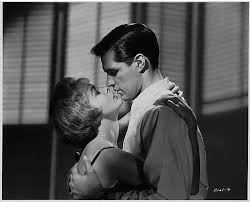
Very suspenseful from the first note — almost shocking in its immediacy. Ostinato and repetition, a driving cyclical motif that establishes from the opening seconds that something is wrong and will remain wrong. Then it shifts — love, temptation, racing thoughts. Almost sorrowful. Marion is deeply unhappy with her situation and the nervousness of the score mirrors the nervousness of the performance. Herrmann is already inside her head before we know anything about her.
Flight / The Patrol Car / The Car Lot / The Package / The Rainstorm
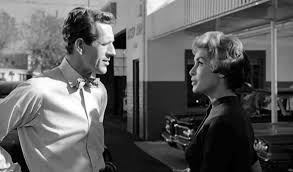
Paranoia. The feeling of being watched. Sombre and heavy with impending doom that builds without release. Cat and mouse — the flight from the police, the wrong turn, the rain. And then a psycho comes. We’re left with incredible tension, and you think the arrival at the hotel might provide some relief. It doesn’t. The music knows what’s coming and it won’t let you forget that.
Hotel Room / The Window / The Parlour / The Madhouse / The Peephole
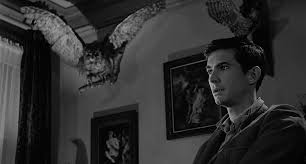
Silent at first, then sharp strings cutting through. Very spooky atmosphere — eerie calmness, strings floating through the mist. Norman Bates is charming and unsettling in equal measure, and the score walks that line with precision. The surface noise on my copy shows up here, which in a strange way doesn’t hurt the atmosphere.
Side Two
The Bathroom / The Murder / The Body / The Office / The Curtains / The Water / The Car / The Swamp
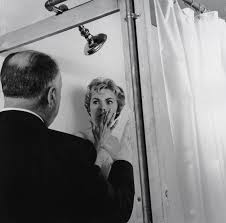
When it all comes to its inevitable, shocking peak. The string concerto. The shrieks. And then the sorrowful aftermath — sparse, sedate, minimal — the music doesn’t release you from the shock but gives you space, long drawn-out phrases, sharp isolated notes, your mind filling the silence with what you just witnessed. And then the swamp, the car sinking slowly down and down, and the musical phrases spiraling downward in the same direction. The whole universe of this film is going down together.
The Search / The Shadow / Phone Booth / The Porch / The Stairs / The Knife
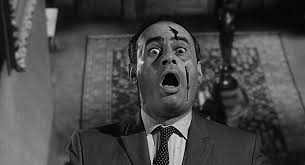
A similar motif returns, but with more purpose behind it now. The stabs come back — but different this time. Something more sinister, more knowing. The difference between shock and realization. The first time you heard these sounds you didn’t know what was coming. Now you do. The music knows you know.
The Search / The First Floor / Cabin 10 / Cabin 1
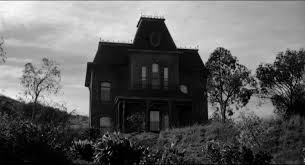
Sustained, drawn-out notes that build and ebb. A flow through the remaining scenes, gathering weight rather than releasing it. The architecture of the score is doing structural work here — you’re moving toward something final.
The Hill / The Bedroom / The Toys / The Cellar / Discovery / Finale
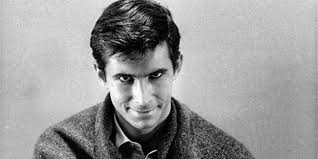
Up and up we go. The plot is fully in command now, information arriving faster than the music can comment on it. And then it gets strange — a creeping quality before the finale, unsettling and odd in a way that’s almost surreal. The ending doesn’t resolve. It lands, but not somewhere comfortable.
Closing
This is a fine recreation of the score on vinyl. The pressing does right by the music — the highs land where they need to and the depth is there. The cover art is a different story, but you’re not buying this for the cover.
Whether this score works as a standalone listen depends entirely on what you bring to it. For some it will be repetitive — and it is repetitive, deliberately and structurally so. But in that repetition there is emotion and a specific kind of beauty. You have to be a willing listener, someone patient with string arrangements and comfortable sitting inside a single mood for the length of a record. If you are, there’s real reward here.
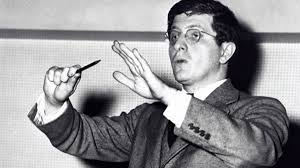
Herrmann believed that music was cinema. For the black-and-white bleakness of this film, he turned in an equally bleak and moody score — spare, unornamented, uncompromising. He and Hitchcock were working in the same register, building the same thing from different ends of the creative process. Black and white all the way through. In the end, the film and the score are inseparable. You can’t hear one without the other.
Thanks for reading.
RTR
 Remember a Day