Live at the Apollo Live Album | Released May 1963 | Recorded October 24, 1962 at the Apollo Theater, Harlem, NY | King Records | Produced by James Brown
One of, if not the most significant live recordings ever made. James Brown’s energy as a musician in a live setting is still damn near unmatched. His energy and work ethic off stage, in the studio, as an advocate for his band and his own self-image as a musician and producer, are equally unmatched. There will never be another James Brown, as cliché as that sounds. There will never be an artist more worthy of the title “Hardest Working Man in Showbusiness.”
James Brown’s road to recording this live album was a rough one. It’s up in the air where he was born exactly, either small-town Tennessee or Macon, Georgia. What is accurate is that he spent his childhood in Augusta, Georgia. Definitely a Horatio Alger story. Young James worked through poverty, family abandonment, prejudice, and delinquency. As a child he shined shoes and danced on the street corners of old Augusta, sometimes falling in with rough crowds and drawing the attention of local police.
I spent some time in Augusta myself and saw the streets as they are today. Definitely not the town of James Brown’s childhood. What I did see was the display of affection and pride that Augusta holds for being the hometown of one of the most influential musicians who ever lived. The Augusta History Museum has a brilliant display of Brown’s memorabilia and clothes, and James Brown even has a small display of honor at the Augusta Regional Airport.
Brown started singing with gospel groups in the late 1940s and began touring. Then in the ’50s he started getting noticed as an R&B singer, distinguished by a powerful voice and stage presence despite his stature. His two early hits, “Please, Please, Please” and “Try Me,” became million sellers, and Brown quickly started to rise to dominance in the R&B game and circuit. His work ethic grew with his career, and he became secure enough to play large clubs and demand nothing less than an agreed-upon sum of around $1,200 a night. The Apollo Theater became the quintessential venue for what would become a landmark live album, even though recording a live album of all-original material was essentially unheard of at the time. It just wasn’t done.
Place this album in its context. Think 1962, the Kennedy administration. Fever pitch. Bottom of the ninth for some Americans. Some people genuinely thought the country and the world were on the brink of full nuclear war. The Cuban Missile Crisis. This show was recorded right in the middle of that 13-day standoff, and folks must have been dancing and singing along to this show thinking it could have been their last night on earth.
The Object
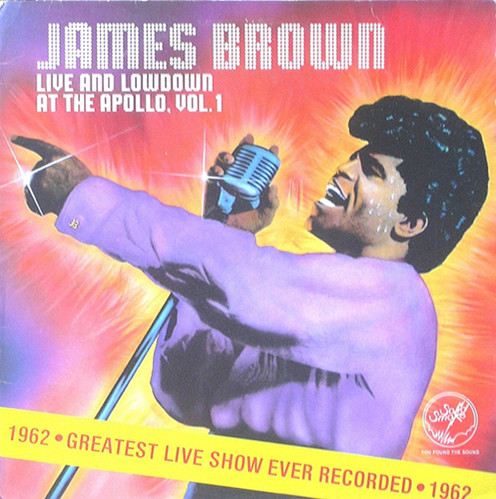
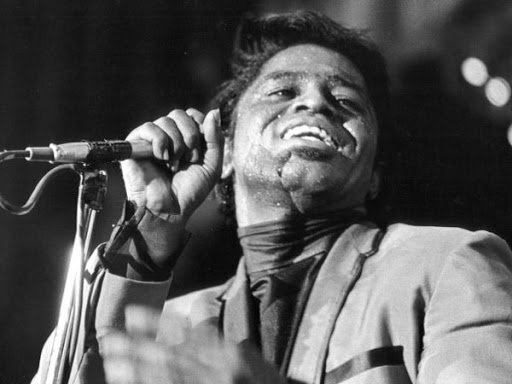
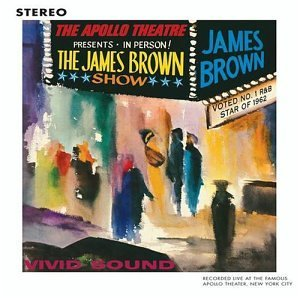
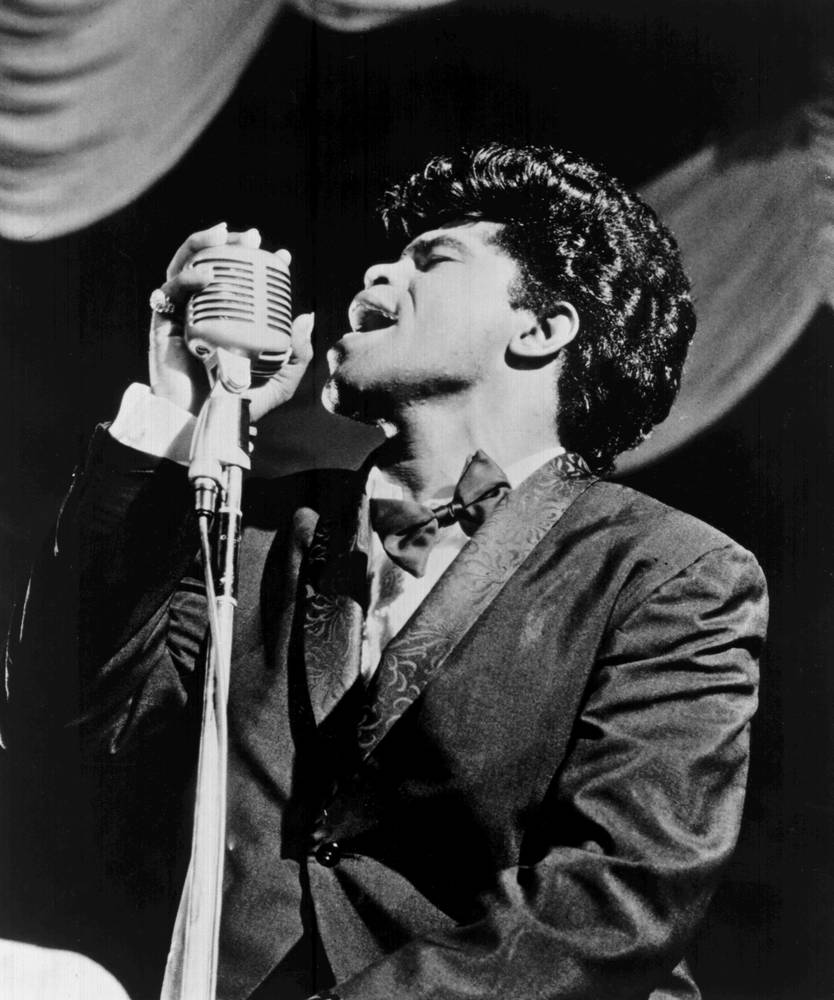
My copy is a curious little reissue from 1980 on Solid Smoke Records. It carries the alternate title Live and Lowdown at the Apollo, which to me is pretty dope and really adds to the lore. The original cover is a slightly impressionistic piece depicting the front façade of the Apollo Theater in Harlem, names and lights and information filling the marquee. That cover is more about the impression and the vibe of the setting, which is important. The Solid Smoke reissue I own focuses more on James Brown himself, giving his name center stage alongside a stylized portrait of the artist in action, beautiful hair, mid-expression toward the audience, microphone in hand, delivering a vocal performance. The cover also makes the claim that 1962 saw the “greatest live show ever recorded.”
I snagged this copy on Discogs at a pretty reasonable price. Originals on the King Records label probably go for much higher. The Solid Smoke release sounds really good. It has that energy captured in the recording and presents it well. The vocal is right where it needs to be, and most folks seem to agree the sound holds up against other releases. Douglas Wolk, in his book on the album, notes that this Solid Smoke release is something of an oddity, and also observes that the vocal appears on the left channel while the instrumentation sits on the right.
The Music
The Apollo Theater and the Chitlin’ Circuit
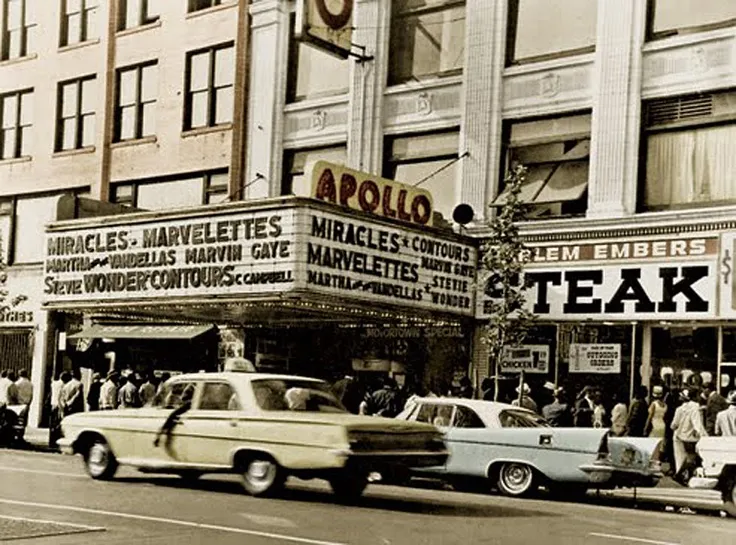
What this record is, for some people, is a portal to another time. A key time in R&B and soul music, the early ’60s, and the cutthroat venues known as the Chitlin’ Circuit. For many, the Apollo Theater was the most demanding venue on that circuit. James Brown eventually established himself enough in the industry to become one of the original artists with a residency there. Think of the importance by recognizing a key predecessor: Little Richard and his band, the Upsetters. Brown and the Famous Flames eventually worked their way up to co-headline the Apollo right alongside Little Richard. Those must have been some great concerts. We can only imagine the energy in that room watching those two performers work their magic.
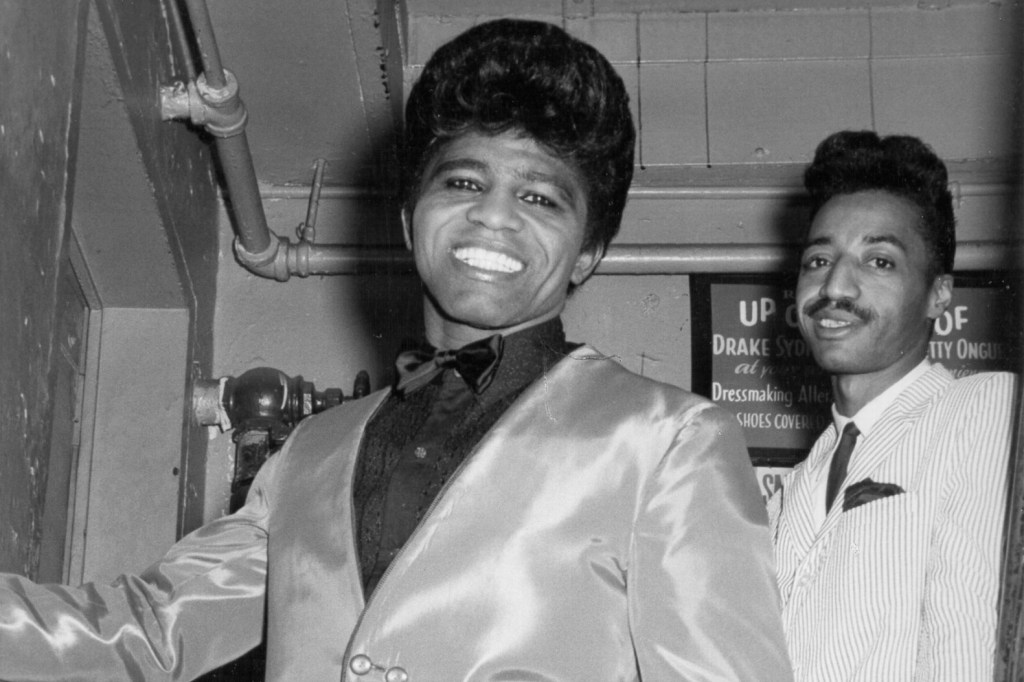
At the Apollo, acts would typically play for a week or weeks straight, performing multiple shows a night. What this record contains in its grooves is only a short snippet of one of those nights. This is Star Time. The headline attraction after a full evening of music, with many other artists preceding. Also important to note: this likely wasn’t the first time the audience had seen James Brown on stage that same evening. An earlier portion of the program was given to the Famous Flames for an all-instrumental set, with Brown playing organ. The anticipation can be felt in Fats Gonder’s introduction and the crowd’s response. This audience was ready for a show.
The Famous Flames, 1962 lineup:
After multiple personnel upheavals, the lineup that performed at the Apollo had stabilized: Johnny Terry (original member, who would later leave to join the Drifters), Bobby Byrd (whose second return became permanent), Lloyd Bennett, and Bobby Stallworth.
At the time this record came out, a live album featuring no new songs or previously unreleased material was an untouched concept in the industry. The recording was produced and overseen by Brown himself.
Part of what strikes me about this recording is how absolutely in shape the band is. That is not an accident. James Brown was a known perfectionist who demanded a great deal from every musician who backed him. Minor imperfections in clothing, such as an unshined shoe, resulted in fines. A couple of notes off pace or out of tune during a performance resulted in a fine. Brown would signal these infractions by flashing his hands in rhythm with the beat. Four flashes meant twenty dollars docked from their pay. Behavior from a man who wanted the best out of his band, or who was simply unfair and unsympathetic to anything short of perfection in his eyes. Bobby Byrd described the system plainly: Brown didn’t want anyone to know what they were doing ahead of time, so he devised numbers and certain screams and spins as cues. The band as a live compositional tool, entirely subordinate to Brown’s will, requiring him to know every player’s strengths and weaknesses intimately. This endless pursuit of excellence was the product of an upbringing no one would be envious of.
Introduction by Fats Gonder and Opening Fanfare
It really doesn’t get better than this in terms of an intro. “Are you ready for Star Time?” immediately establishes what is about to follow. I’m sure that question and that term have long since entered the musical history zeitgeist. What makes this intro even better is the band’s full involvement, and the string of sobriquets Gonder unleashes.
Fats Gonder really didn’t have to be this effective when he introduced James Brown, but one wonders how much pressure he must have felt. He was not only the emcee for the evening but also an organist in the band. Unclear why the role landed in his lap, but man, it’s a great introduction, and one that Danny Ray, the second hardest working man in showbusiness, aka the Cape Man, aka the number-two to James Brown’s number-one, would go on to emulate in all future shows.
Gonder’s intro begins:
“Nationally and internationally known as the hardest working man in showbusiness…”
That title was originally attributed to Little Richard. Sometimes Little Richard would ghost shows, and James Brown would fill in. The title gradually started to precede James Brown’s name instead.
Then Fats goes into a greatest hits list, and with each track mentioned, the crowd response grows progressively louder, until the final bang with “Night Train.” Between each song title there is a note, and with each note the progression and tension rise. The pot is boiling over.
I’ll Go Crazy. Try Me. You’ve Got the Power. Think. If You Want Me. I Don’t Mind. Bewildered. Love Someone. Night Train.
Mr. Dynamite! Mr. Please Please! The Star of the Show! Mr. James Brown and the Famous Flames.
Important to note here that Gonder does a great job as master of ceremonies by not leaving out the full title of the band. Not neglecting the Famous Flames. They are stalwart musicians backing James Brown, and they deserve the credit, even if they didn’t always get it from the man himself.
By the time Gonder gets to that ending, the crowd is like a primed engine ready to blow their frigging top. And then the band flies straight into the first song, bass line and drums and guitar and horns just exploding with energy. One of the more memorable introductions to any live show I can recall.
What I imagine happening with the opening fanfare, and it’s easy to imagine if you’ve seen any footage of Brown’s work on stage, is his stage entrance. Ever the showman, his intros were some of the finest pieces of expert showmanship in the game. Fast dancing his way to the mic, or strutting and then dancing, sliding up to the microphone like he was born to do it. Many argue he most assuredly was born to play shows, and this recording proves it.
I’ll Go Crazy
Written by James Brown, this track was one of his first singles, from 1960, originally recorded in November 1959.
Brown’s entrance gets the crowd to fever pitch all over again. The background vocals from the Flames are great here, and the band is right in touch with Brown, which was sometimes easier said than done. As the band worked with Brown, they had to learn how to follow his movements and commands, punctuating his shouts and hollers with horn bursts and drum hits.
Here you can feel how good the band is and what a counterpoint that creates to James Brown. James delivers this vocal with confidence and swagger, claiming he will definitely go crazy if this person leaves him. The Flames act as the mediator between James and the object of his affection, imploring him to calm down and her not to leave him.
Try Me
Once Brown announces the first words, the crowd screams in recognition and excitement, and Brown settles into this ballad. One of his earliest singles, preceded only by “Please, Please, Please,” it was a number one hit in 1958. You can feel that popularity in the crowd’s response when Brown kicks it off. Short and sweet here on the live record, but very effective due to Brown’s heartstrung vocal.
Think
This track was originally written and recorded in 1957 by a group called the 5 Royales, on James Brown’s same record label, King Records. The James Brown version, especially the one here on the live album, is incredibly sped up, to the point of near ridiculousness. Taking a song and accelerating it into something urgent became part of the MO for Brown and the band.
The live version is an uptempo clapper, with a strumming guitar, an instrumental jump-and-jive energy that really moves at pace. Those claps, and the way James Brown is so frenetic in his delivery, you can almost picture him cutting some seriously professional dance moves while he sings it. The track comes and goes quickly. For a moment you’re in it and then you’re out of it.
I Don’t Mind
Originally recorded in September 1960. The studio version feels a tad different from the Live at the Apollo version.
The live version is amazing, even if it feels slightly off-kilter in some ways. It sounds like the band is negotiating a strange pace with Brown. Listen closely with headphones and the reward is you start to hear the crowd really becoming involved. A woman in the audience screams after Brown’s “I’m gonna miss you.” She says, I sure do, baby.
The vowel vocalizing from the background singers is my favorite part of this song on the live record. There’s something about the register they’re in that’s transporting in a way that’s so emotionally affecting. This is an off-kilter track, but to me it’s a high point of the recording.
Lost Someone
After the final instrumental interlude, we’re now into something completely different from what came before. After the opening run of hits, what’s coming is a stretch of improvisational, pure musical emotion. A live performance hitting its extreme peak and not relenting until the final note.
Brown starts with another introduction, something like what Fats Gonder did, but this one is James. He’s pleading with the audience to feel what he feels. And when he finally gets into the first line, “I lost someone,” we are fully engaged in this long, drawn-out song full of vocal power.
The responding muted horns after each line are a welcome, easy punctuation to the vocal prowess Brown displays. He’s really going for it, and each crash and horn response is the cue for the crowd to respond. And respond they do. By now they are screaming in ecstasy.
The repeated “I’m so weak.” He gives each one the same justice. Douglas Wolk posits that even here, since Brown knew he was being recorded and wanted to avoid distortion from overloading the microphone, he was holding back. It’s really difficult to comprehend that. With “I’m so weak,” he sounds distant from the mic, perhaps offering more to the live audience in the room than to future audiences listening in the living room. But his method here is an amazing piece of solo artistry. It demands to be heard.
On the 1980 Solid Smoke reissue, this track is split in half between the last song on side one and the first song on side two. An interesting quirk for folks back then. To my ears it’s a tad jarring. Full recordings of the track are out there and worth seeking out to really hear the power and feel the whole arc of the performance. It’s remarkable through and through. A two-minute pop song stretched to eleven minutes. That was just insane for 1962.
Medley: Please, Please, Please / You’ve Got the Power / I Found Someone / Why Do You Do Me / I Want You So Bad / I Love You Yes I Do / Why Does Everything Happen to Me / Bewildered / Please, Please, Please
Within this medley we hear a touch of “Please, Please, Please,” the song that put Brown on the map and was his first hit. The crowd’s response when that kicks in is just staggering. They have been waiting for this moment for hours, or for some, probably their entire lives.
What a curious song “Please, Please, Please” is. For Brown it’s a signature, one of his likenesses. And it’s a one-word chorus. That’s James Brown for you. The man only needed one word to make his effect.
That effect is felt for about the first thirty seconds of the medley. A brief notice of the full track, but enough to set the proverbial souls of some audience members on fire. They are literally going insane.
“You’ve Got the Power” is given only a brief snippet, barely the first line, before it moves on. “I Found Someone” gets thirty-nine seconds and functions as a natural answer song to “Lost Someone.” “Why Do You Do Me” is blink-and-you’ll-miss-it, only four lines, Brown in a lower register. “I Want You So Bad” gets another four lines of ballad. “I Love You Yes I Do”: Brown sings the first line in crooner mode and the band responds by going into the track. Astonishingly, it’s been noted that this medley was not prearranged. The band had to follow Brown’s cues, whether vocal or gestural, to know when to be ready. I’ll go ahead and say it: that’s insane, and I don’t know how they did it. They deserve recognition as some of the hardest working musicians in showbusiness. There’s also some great organ work in this stretch.
“Why Does Everything Happen to Me” gets another short snippet, the crowd rolling along with what’s happening. “Bewildered” gets only twenty-five seconds, four lines, but that first Bewildered shoots the crowd off like a rocket. And then the finale of the medley turns back into “Please, Please, Please.” We’re back where we started, and the crowd and the band are back with us. We’ve just traveled through Brown’s late ’50s and early ’60s career in under five minutes.
Was this where the cape routine happened? The cape routine, where Brown falls to his knees, pleading for mercy or forgiveness or submission, whatever you wish, and one of the band members, later it would be Danny Ray, comes over and drapes a cape over the singer as an offering of respite from the pain and sorrow of the performance. By the time of this recording, the cape routine would have been well known enough that Brown didn’t need to draw it out. The two pieces of “Please, Please, Please” would have been enough to trigger the image in everyone’s minds. On the recording the same effect is there. We must imagine some form of the cape routine likely occurred.
Night Train
A jazz standard from 1951, originally recorded by Jimmy Forrest. James Brown first recorded his version in 1961, replacing the original lyrics with a list of cities on his East Coast touring circuit. On this live record, that tradition maintains, and it makes for a deeply moving finale to everything that came before. It gets the folks moving, that’s for sure. And it’s got that train motif, which by tradition is a passed-down metaphor for the life of the musician. The constant movement, the place-to-place lifestyle that so many artists come to love and live with. The long lonely nights. The city-to-city movement. The loneliness. The Night Train coming along.
James revisits the narrative: I’ve lost someone, but I know where to find them. All aboard?
The crowd answers, and someone in the audience knows what’s coming, responding with the song title before Brown even announces it. It’s the Night Train.
He starts southern and moves north: Miami, Atlanta, Raleigh, Washington D.C. Wait, we forgot Richmond, Virginia. Back north: Baltimore, Philadelphia, New York City, Boston. And finally, New Orleans gets the most honorable mention. The home of the blues.
If you think to today, the modern hip-hop or rap artist mentioning all the towns where they have people, you start to wonder if this litany from James Brown was the first example of that method.
The music is pretty simple. A recurring guitar riff and a blast of horns driving alongside it. Motivating and relentless to the end. The Night Train carrying him home. New York City, the end. He goes a couple of rounds, like an ouroboros. The tour circle keeps going round and round. The conductor is James Brown. He wants us all to come along with him, and whether we like it or not, we’re going to come along. Captivating.
Night. The way James Brown closes this show. A fitting ending to an amazing piece of recorded music.
Closing
Live at the Apollo marks a specific moment in the life and career of James Brown. It also marks a specific moment in history. Harlem, New York. The Apollo Theater. The Chitlin’ Circuit. The United States, in the midst of an unprecedented paranoia: the Cold War, Soviet aggression, civil rights, nuclear war. Amidst all of it, James Brown and his band are putting out Black energy to a Black audience that probably needed it most. If that’s not a formula for a legendary show and a legendary recording, I don’t know what else you need.
The legacy this album holds is impeccable. I really enjoy hearing about how DJs would play the entire first side uninterrupted, giving it the honor and space to breathe and letting the effect land. It’s one of the most memorable live records ever made. It was James Brown’s idea, and it became a massive commercial success. After this record’s release, it went to number two on the Billboard 200 pop album chart. The R&B albums chart didn’t yet exist. The success of this record led Billboard to create the R&B Albums chart in 1965.
The record made James Brown a megastar. We must all bear witness to this creation. Hear it and visualize it for yourself. Hop on the Night Train. Go visit the Augusta History Museum and read up on the star. Be educated. James implores us all, children.