Studio Album | August 17, 1959 | Columbia Records
Recorded March and April 1959 | Produced by Irving Townsend
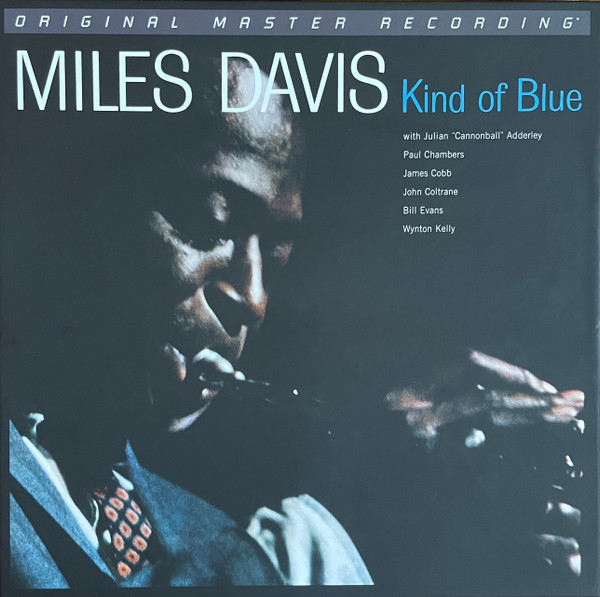
My pressing: Mobile Fidelity Sound Lab (MOFI) Box Set, 2021 · 45 RPM · Purchased on Discogs, 2026
For many people, this is their first jazz album. It wasn’t mine — but it became one of the most important records in my understanding of what jazz could be.
I’ve been with Miles for a long time. I read his autobiography around 2018 or 2019, trying to understand the man and his music together. That book was my real introduction — not just to Miles, but to the wider world of jazz. Alongside Coltrane and Mingus, he forms the triumvirate that defines what I think of when I think of jazz greatness. Miles is the one I’ve followed most closely, given the most listening effort, and what comes back from that is a tremendous satisfaction. He was one of the best instrumentalists and pure musicians who ever lived. Full stop.
I’d owned Kind of Blue on CD for years. Putting off the vinyl was intentional — I wanted an honest copy, something that did the record justice. The MOFI box set from 2021 was the answer. I bought it on Discogs in 2026, arrived open but in solid condition and ready to spin. The box is well made. The records are high quality. Each piece of music gets its own side or half-side at 45 RPM, which gives every track room to breathe. It’s a serious presentation of a serious album, and it sounds like it.
Historical Context
1959 was a year of radical divergence in jazz. John Cage could have been speaking about the music of that year when he said, “We are all going in different directions.” Ornette Coleman’s The Shape of Jazz to Come, Charles Mingus’s Mingus Ah Um, and Dave Brubeck’s Time Out all arrived that year — the latter two on Columbia, same label as Miles. Four dramatically different statements about how to organize jazz music. Each avant-garde in its own way. Each arguing for the technical possibilities and aesthetic reach of the music. Kind of Blue landed in the middle of all that, and somehow became the most enduring of them all.
The album was recorded at Columbia’s 30th Street Studio in New York — a converted church with natural acoustics that Columbia relied on heavily for both jazz and classical recordings throughout the fifties and sixties. The room is part of the sound. That warmth, that space, that sense of air around every instrument — some of it is the playing, and some of it is the building.
Miles was always a chameleon. Jimmy Cobb said he craved change, that he lived in the unknown and didn’t give any care about the consequences. By 1959, Miles had already moved through bebop, the Birth of the Cool sessions, and the hard bop of his First Great Quintet. Kind of Blue was a deliberate move away from all of that. The switch to modal improvisation was a rejection of the dense chord changes of hard bop — Miles wanted open space. He wanted his musicians to invent in real time, without the furniture of a complex harmonic map getting in the way.
It’s as much a Bill Evans record as it is a Miles Davis record. The two men had been working through modal ideas together for some time before the sessions — Evans introduced Miles to Ravel and Khachaturian, and their conversations about scales, space, and color shaped the album’s entire conception. Miles said plainly: “I planned that album around the piano playing of Bill Evans.” Evans wrote the liner notes. He developed the frameworks for several tracks. Miles retained sole authorship credit, a decision that remains contested, but the collaboration was real and deep.
The classical influence runs throughout. Debussy, Ravel, Bartók, Stravinsky, Khachaturian — Miles spent six months listening carefully to Khachaturian before these sessions and told Nat Hentoff in 1958 that what intrigued him was “all the different scales he uses — they’re different from the usual Western scales.” That search for new scalar resources is exactly what Kind of Blue delivered.
None of these tunes were written out beforehand in any conventional sense. Miles arrived at the studio with sketches — outlines, scales, frameworks — and talked the band through them on the day. No rehearsals. First takes. What you hear on this record is musicians encountering the music for the first time and finding their way through it together. That’s the spontaneity you feel when you listen. It isn’t a myth. It’s documented.
The Musicians
Seven people walked into 30th Street Studio in the spring of 1959. The average age was 28.
Miles Davis — Trumpet — Age 32
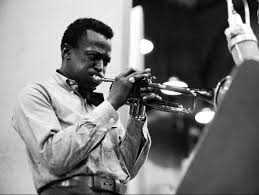
Leader and composer. The King of Cool. Miles plays trumpet throughout, frequently with a Harmon mute, which gives his tone that intimate, almost whispered quality that defines much of this album. He was the architect — the one who set the parameters, chose the musicians, and created the conditions for what was about to happen. He didn’t always give detailed instructions. He didn’t have to. He knew who was in the room and trusted them. His solos on Kind of Blue are lessons in restraint: he gives you just enough, holds back just enough, and makes the space between the notes feel as important as the notes themselves.
John Coltrane — Tenor Saxophone — Age 32
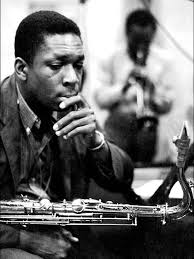
Coltrane was developing what would become known as his “sheets of sound” approach — dense, cascading, harmonically complex runs that were the opposite of everything Kind of Blue was asking for. The album caught him at a crossroads. Modal playing required him to slow down, work with less, and resist his instincts. In his own words: “There was a time in the past that he was devoted to multichord structures… But now it seemed that he was moving in the opposite direction to the use of fewer and fewer chord changes.” The tension between his instincts and Miles’s vision is audible, especially on Flamenco Sketches — and it’s part of what makes his playing here so compelling. He wasn’t fully comfortable, and it shows in the best possible way. Within a few years he would record A Love Supreme and reshape jazz again.
Cannonball Adderley — Alto Saxophone — Age 30
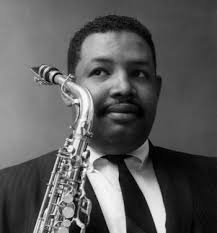
Cannonball joined the group in 1958 and remained something of a legend in this lineup. His playing is warmer and more rooted in the blues than Coltrane’s, and he functions as the center of gravity between two extremes. Where Miles holds back and Coltrane pushes outward, Cannonball swings. His solos have a naturalness and ease that ground the record. His work on Freddie Freeloader in particular is some of the most joyful playing on the album.
Bill Evans — Piano — Five Tracks — Age 28
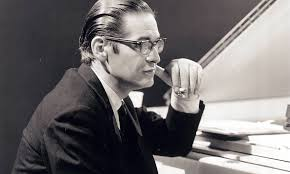
The essential collaborator. Evans had actually left Miles’s working band before the sessions — Wynton Kelly was the regular pianist — but Miles brought him back specifically for Kind of Blue. His impressionistic approach to the piano, rooted as much in Debussy and Ravel as in jazz, gave the album its particular atmospheric quality. His piece “Peace Piece,” recorded in 1958, provided the direct foundation for Flamenco Sketches — Miles heard it, liked it, and the morning of the second session the two men went to Miles’s apartment and worked out the five-scale cycle together at the piano. Evans sketched the scales out on a small piece of staff paper and wrote the instruction: “play in the sound of these scales.” Jimmy Cobb said afterward that the music sounded more like what Bill would play than what Miles would play. It’s an observation about how deep the influence ran.
Wynton Kelly — Piano — One Track — Age 27
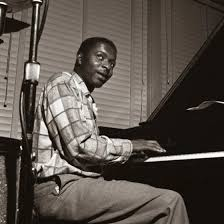
Kelly plays on exactly one track — Freddie Freeloader — and it’s the most traditionally swinging moment on the album. His earthier, more blues-rooted style suited the 12-bar blues structure of the track better than Evans’s impressionism. Evans himself reportedly felt he had little to add to that particular song, and Kelly’s presence there is exactly right. The contrast between his playing and Evans’s across the album is one of the subtle pleasures of listening closely.
Paul Chambers — Bass — Age 23
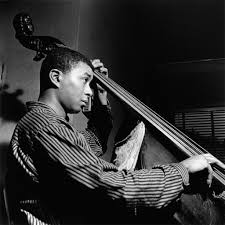
Chambers had been working with Miles for four years by the time these sessions took place, and his opening bass line on So What — stating the melody before Miles even enters — is one of the most remarkable moments on the record. He was 23 years old. His playing holds the album together with remarkable poise for someone that young, and the warmth of his tone is a constant throughout. He died in 1969 at 33, largely without the recognition he deserved.
Jimmy Cobb — Drums — Age 30
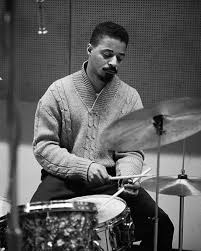
Cobb joined the band after Philly Joe Jones departed and brought exactly what this music needed — restraint, openness, and a willingness to serve the moment rather than dominate it. He played brushes rather than sticks across much of the album, and Miles’s instruction was simple: keep it light, keep it open. Cobb honored that completely. He spoke about the sessions extensively in the Birth of the Cool documentary. He was still performing into his eighties and passed away in 2020 at 91, the last surviving member of the Kind of Blue sessions.
The Music
All tracks recorded at Columbia’s 30th Street Studio, New York City
Record 1
So What | March 2, 1959 | Session 1
The great opening. Chambers states the melody in the bass before anyone else plays a note — an extraordinary compositional choice that sets the tone immediately. When Miles enters, he gives you just enough. It’s a “so what” solo in the best sense — unhurried, deliberate, almost indifferent in the coolest possible way. Coltrane’s solo opens up and goes somewhere freer. Cannonball follows with something more down to earth. He’s the middle between the two extremes of Miles and Coltrane, and that dynamic plays out across the whole record. The sound quality on this MOFI pressing on this track is superb.
Freddie Freeloader | March 2, 1959 | Session 1
The blues. Wynton Kelly on piano instead of Evans, and you feel the shift immediately — something earthier and more settled in the groove. The blues structure lets the musicians move around and feel comfortable in the way that a standard blues always does. Miles’s solo here has more joy to it, a little more generosity, his horn right up in the mic. And the way Coltrane enters this track — huge, insisting his voice into the recording — is one of the great moments on the album. Cannonball delivers another carefree solo. Kelly is exactly right throughout.
Blue in Green | March 2, 1959 | Session 1
Slow down and settle in. Miles’s intro feels like a quiet stroll around the recording room — no urgency, no statement to make, just a presence. Bill Evans’s piano is the shining moment of this record for me. There’s a depth of emotion in his playing on this track that’s hard to articulate. He wrote the music. You can hear that it came from somewhere real.
Record 2
All Blues | March 2, 1959 | Session 1
A 12-bar blues in 6/8 — Miles took the standard blues form and gave it a waltz feel, which opens the whole thing up. There’s an urgency to it, a forward motion that’s different from what came before. Miles floats on top of that rhythm wave. One of the real pleasures of this album is hearing how distinct the three voices are — Miles, Coltrane, Adderley — and All Blues is a good place to sit with that. They’re three entirely different personalities contributing to the same conversation.
Flamenco Sketches | April 22, 1959 | Session 2
My favorite track. It reaches somewhere the others don’t. The structure is unlike anything else on the record — five scales, each soloist moving through them at their own pace, no fixed time, no formal repetition. Beauty out of improvisation. I don’t always follow the jazz mechanics and theory, but I know what this sounds like. It’s music to think by. It’s music that moves the way thought moves — associative, patient, occasionally surprising. It reminds me of Sketches of Spain, another Miles record I love, and I don’t think that’s a coincidence.
The ending is somewhat abrupt, but it tails off beautifully. It ends the way a good conversation ends — not with a conclusion, just a quiet agreement to stop talking.
Closing
This is the record that lifts any situation. It’s romantic and direct. It works in the foreground and the background. I hear something new every time I play it. It’s perfect for any occasion and takes me somewhere that makes me appreciate art in the best way — which is quietly, without needing to explain it.
I’m not a jazz scholar. I’m a lover of music and musicians, and what I appreciate is the story of how artists move through their lives and what they leave behind. The story of Kind of Blue, and Miles Davis’s life leading up to it and after it, is a perfect distillation of what it looks like when an artist commits fully to doing his own thing. An exhibition of the unknown. A drift into the new.
In some ways Miles was never the same after this record. It shot him into a wider popularity and defined this period of his career. He kept doing great things — the electric years, Sketches of Spain, Bitches Brew — but Kind of Blue stands apart. If you’re coming to Miles for the first time, this is where you start. If you’ve been with him a long time, this is where you return.
Essential item in the collection. I can put this on for anyone, any time, and the day will be better than it was before.
RTR
Further Exploration
3 Shades of Blue: Miles Davis, John Coltrane, Bill Evans, and the Lost Empire of Cool — James Kaplan
Miles: The Autobiography — Miles Davis with Quincy Troupe
Kind of Blue: The Making of the Miles Davis Masterpiece — Ashley Kahn
Miles Davis: Birth of the Cool — Documentary, dir. Stanley Nelson, 2019
 Remember a Day
Leave a comment