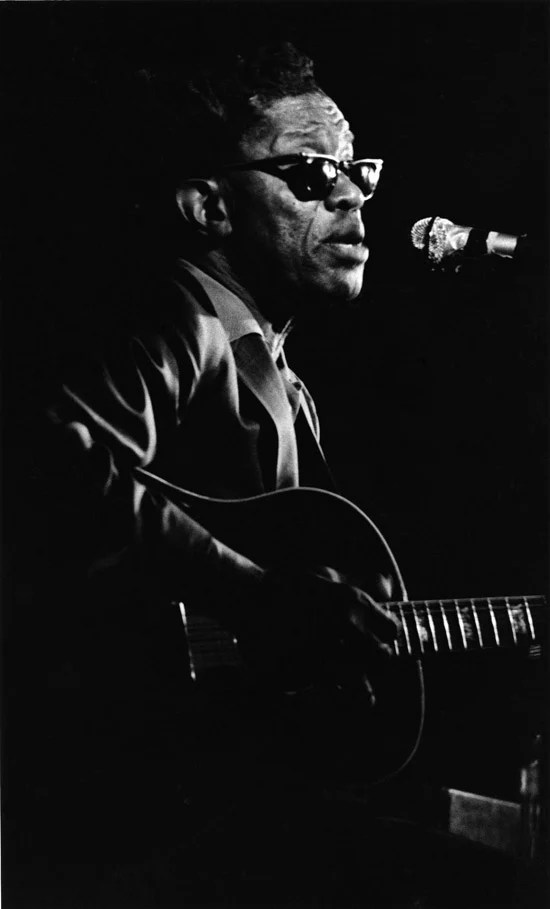
Studio Album | Released March 1965 | Recorded May 4th and 5th, 1964 either in New Jersey at Van Gelder Studio or in Houston, Texas | Prestige Records | Produced by Ozzie Cadena
What draws me to Lightnin’ Hopkins comes down to two things: 1. His eternal association with Houston, Texas, and 2. His style. Lightnin’ was one hell of a wordsmith, a Texas bluesman who hoovered up all sorts of life experience and poured it into his songs, some of them made up on the spot. He could turn a phrase in the middle of a verse with ease. He had that knack. His way of singing is uniquely his. On some songs he comes off as an accomplished, conventional bluesman, with a sweet, low down style of spitting lines. On others, his talking blues numbers, he’s the cosmic dark narrator, channeling something from across the spiritual divide, or something he’d seen on his travels. On this generally overlooked record in his catalogue, that distinct style runs through every track.
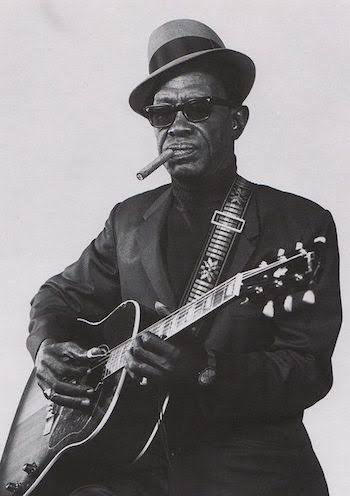
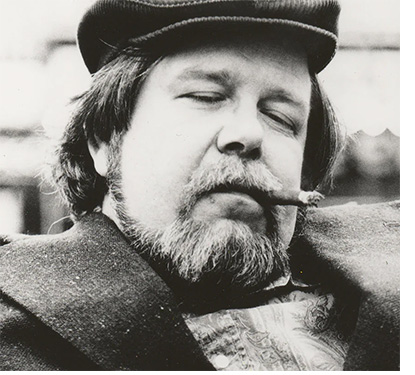
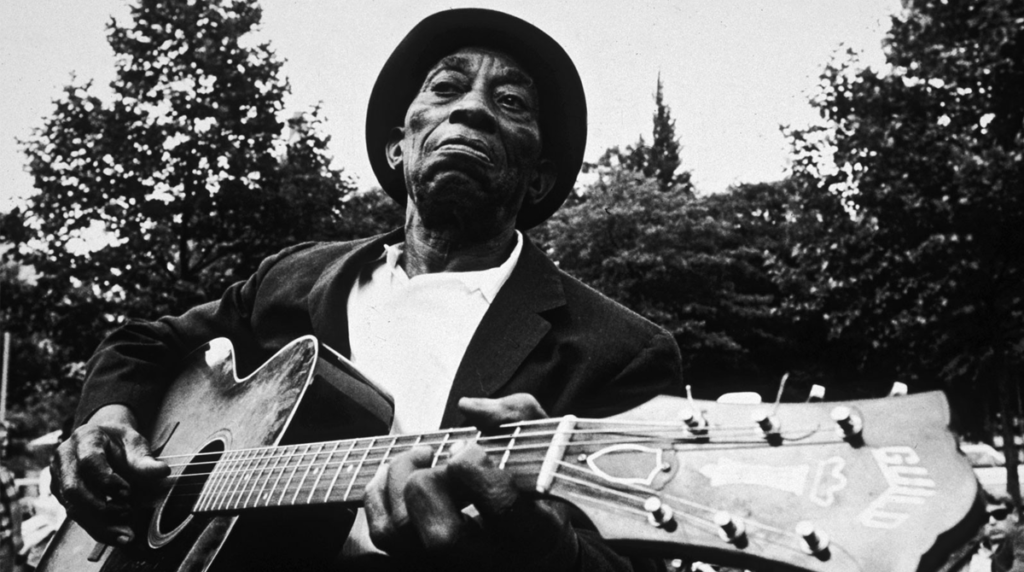
Lightnin’, by many accounts, had presence. He was scary and captivating at the same time, and his stage presence must have been something else. The gold teeth bedazzling a curious grin, the dark sunglasses, the cigarettes and whiskey bottle always at hand. Enough swagger to captivate an entire generation of young white listeners, who pushed record companies to track down and revive these long forgotten artists. What we have in these 60s recordings, like the ones on Soul Blues, is a bluesman in the last third of his life, long steeped in travel and the blues. That presence IS felt on this record: in the voice, in the songs, in the effortless guitar work. Lightnin’ is another of my favorite examples of the lore of the bluesman. He is a figure to look at and listen to in wonder.
This record frames Lightnin’ in his slower, jazzier habitat, a long way from what he might have sounded like early in his career in a juke joint or dive bar in Houston. When you think of blues artists, you don’t typically think of records as a concept. In blues at this time, the concept record didn’t really exist. Record companies recorded and produced the man, and the songs spoke for themselves. The name goes at the top: check out this guy’s style. The title here is Soul Blues, as opposed to blues without soul? Soul taking blues, more like it. This record shows off Lightnin’s soothing and spooky solo vocal style well. He was being recorded at a rapid pace at the peak of the blues revival years, 1964 and 1965, and he cut a lot of records. This one is special and deserves to be looked at and remembered.
Sam “Lightnin’” Hopkins was born March 15, 1912, in Centerville, Texas, and died January 30, 1982, in Houston, of esophageal cancer, at age 69. He lived for years in Houston’s Third Ward. I’m somewhat acquainted with the Third Ward. I commuted to the University of Houston for my BA in Journalism and English Literature between 2012 and 2014. I drove the roads of the Third Ward in high school too, eating at the original Frenchy’s Chicken and shopping at Screwed Up Records & Tapes. No matter how much ramblin’ I do, living where the Army has taken me and shooting across the world and such, I’ll always have a place in my heart and in my blood for Houston, Texas. That melting pot. I must note here, though, that I grew up in and saw a very different Houston than Lightnin’ did. Most of the venues, studios and hangouts he frequented are long gone, and entire new genres of music have sprouted since his passing. But the Lightnin’ presence, I think you can still feel it. It lives on in some of the slowed down, spooky rap music you could hear coming out of Houston in the early 2000s. You can feel Lightnin’ Hopkins in Pimp C’s music, style and lyrical swagger. Lightnin’ left his mark on the blues everywhere, but especially in Houston, for those who look hard enough.
Po’ Lightnin’ did indeed have a rough upbringing in Centerville. Supposedly his grandfather was a slave, and his father, a cotton and corn farmer, was killed in a card game when Lightnin’ was three years old. His mother raised little Sam and his four older siblings. Lightnin’ picked cotton and lived under brutal racism. Poor as fuck. As the story goes, he got hold of his first guitar by nailing a plank to a cigar box and using screen wire for strings. Early stories of Lightnin’ include traveling to real back roads country gigs, dodging the white police, and doing time on the Houston County prison farm in the mid 1930s. Also a real short lived marriage, the woman likely refusing to put up with Lightnin’s lifestyle.
- Met Blind Lemon Jefferson at a church picnic around age 8 and later learned from his cousin, singer Alger “Texas” Alexander. Got the “Lightnin’” name at his 1946 Aladdin session, when he was paired with pianist Wilson “Thunder” Smith. Those nicknames were a marketing tactic. Lightnin’ usually referred to himself as “po’ Lightnin’,” to gather sympathy for himself and also to align his plight with that of his audience. On a lot of his records this plight shines through. He just wants to pick. He wants to express himself through his art. He wants to have a good time. And he had the balls to push through the hard times that gave him the space and energy to make all that happen.
Centerville: I grew up in the Houston area and never visited or even passed through Centerville. From what we see in the Les Blank film, it’s rough cotton country, out near the Brazos and Trinity rivers. This is real small town Texas. Life isn’t easy there for some, but it’s simple. Lightnin’s music and his words are where I feel the heartbeat of small town Texas. In my mind, though, it’s a nighttime image. It’s dark for some reason. The night makes small towns take on new meanings for me. The edges of town, the roadways and cemeteries on the outskirts, hauntings behind every tree: that’s a Lightnin’ Hopkins verse and vocal performance.
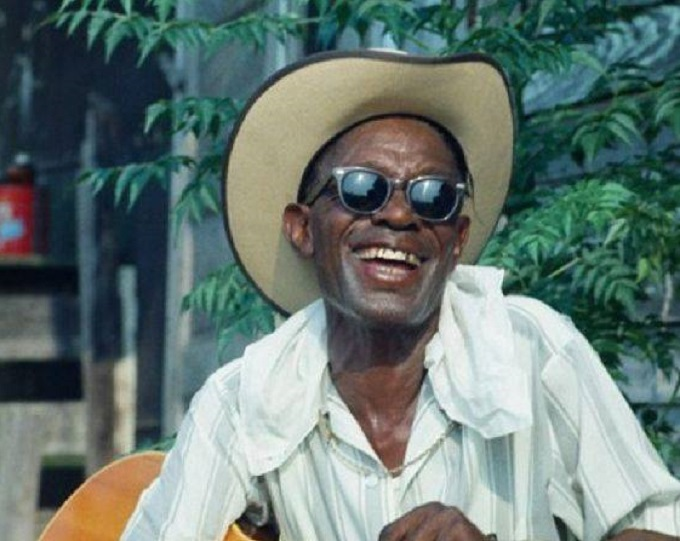
Lightnin’ first came to Houston in the late 1930s and eventually settled for good in the Third Ward, just southeast of downtown. He took to music full time, playing on street corners and making up songs off the cuff, gambling and drinking whiskey, really just getting by. He started playing the juke joints, his style built around the twelve bar blues, or in his case thirteen or fourteen bars. He would make up the words to some songs as he went along, and the same song was rarely played the same way twice. He would repeat himself, he would rap, he would get down on the floor and wail on his guitar. It must have been pretty amazing to see, and this music was a real tonic for the crowds of hard living Black folks in the Houston area. This is where he liked to play. He refused to go on large tours, and he didn’t want to fly on planes.
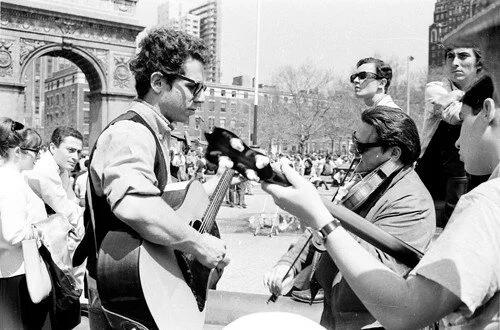
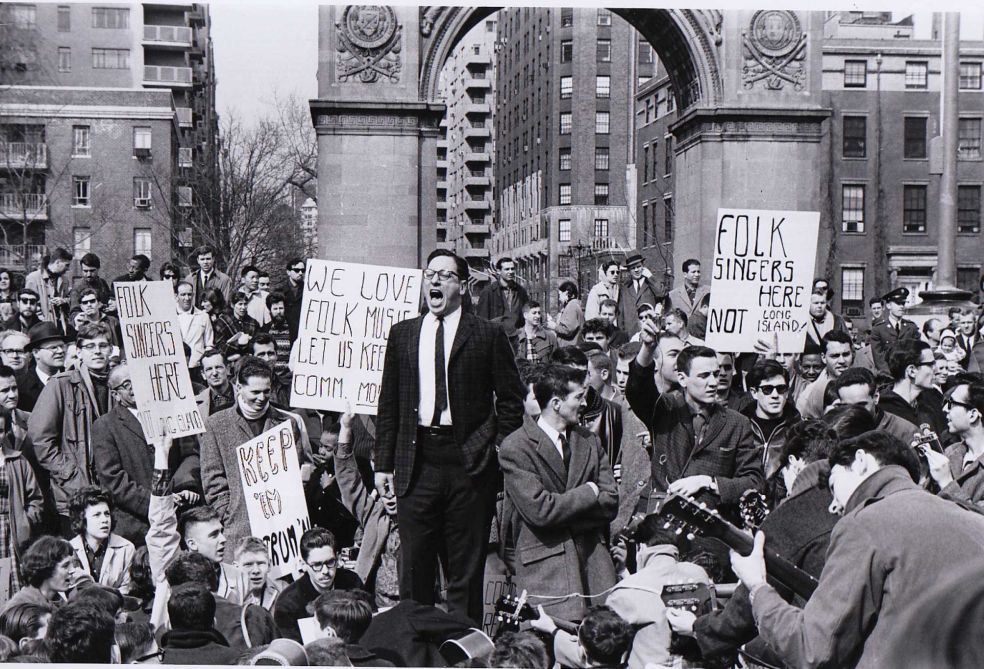
Like many of these blues legends, Hopkins was rediscovered in the late 50s and early 60s by white record producers and folklorists looking to capitalize on young people’s demand for blues and folk artists. The young people were hearing folk music inspired by traditional artists, and they wanted to hear where that inspiration came from. These guys were still alive, and they were willing to record and have their music cut on vinyl. Soul Blues was a product of that blues revival movement. This record must have been in a lot of rockers’ stacks of vinyl from that time period. The Beatles, Bob Dylan, the Stones, the Byrds, the Beach Boys, they all had to be checking out Lightnin’s skills. Lightnin’s influence had gone skyward. In 1964 he made it to England and played the American Folk Blues Festival, but he didn’t seem to like it. He really didn’t like to fly on planes, this OG.
The man lived a life dedicated to the blues. Sadly, that dedication pushed a lot of people in his life to the margins, including his close family, his children and his mother. He was stubborn, paranoid and suspicious of just about everyone. He thought people were out to get him. Hear his profession in his own words, from the amazing short film by Les Blank, The Blues Accordin’ to Lightnin’ Hopkins (1968):
The Object
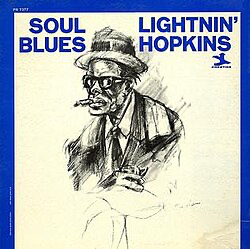
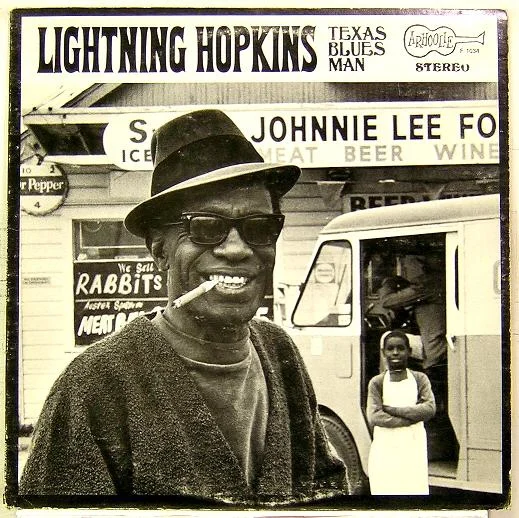
My copy is a reissue: the 1991 stereo remastered issue from Fantasy’s Original Blues Classics series, which brought the Prestige catalog back into print. To my ears, and for a record pressed in the early 90s, it’s a great recreation of Lightnin’s mid 60s sound. I’m sure the Analogue Productions reissue from the fine folks at Acoustic Sounds sounds much improved over this one, but here we are, not complaining, with what I consider the best set of Hopkins tracks. The caricature of Lightnin’ by Dan Sinclair, which looks half finished, is truly great. He’s donned in his typical sunglasses, cigar and top hat. But here he is in a suit, looking as if he could be attending a funeral, maybe his own? The long look, like he’s awaiting the lonesome graveyard (the final track). The border of the LP is a deep blue, and the lettering for Soul Blues and Lightnin’ Hopkins is in that same blue. This is the blue you must be thinking of when you hear the term “the blues.”
The liner notes are by Chris Albertson, dated September 1965. The general theme of these notes is Hopkins’s identifiable character and personality, and his undeniable uniqueness: wisdom, humor and pathos, the full package, pressed into the grooves of the vinyl disc. I got this record on Discogs about seven months ago, in March 2026. It’s not the first Lightnin’ record I’ve owned, but it’ll be the one I put on when I want to hear the best example of his vibe.
The Music
I’m Going to Build Me a Heaven of My Own
Hear tell the confessions of a true ladies’ man. This is a great example of how naturally Hopkins talked his way into a song. The performance is so loose and relaxed that it suggests these lines, and these songs, were partly composed in the studio. There’s a line from Lonnie Johnson in the liner notes: “you don’t just sing the blues, you have to feel the blues.”
The intro: Lightnin’ dedicates the song to the whole world, but especially the “womens” of the world. What he means here is that this song is his appreciation for women. He’s gonna build a heaven of his own, just for women. No men allowed in there, he confesses. He doesn’t explain how he’ll build it.
He won’t call himself Jesus. He can’t exert any power over this heaven. He can’t be the god in control of it, because there is only one God. However, Lightnin’ explains that if he sees this God walking down the road, he’ll kindly explain that He’s not allowed in the heaven Lightnin’ has made for all the women of the world. The middle section of the song continues Lightnin’s questioning of God, placing himself, or mythologizing himself, as God’s equal in stature.
He suggests to God that they both should pray, that that would be the best thing for them to do. To me that’s an indication that things are not very well in the world of Sam. This is no simple blues. This is cosmic blues. To actually demand that God pray, over a state of things so bleak that God him/it/herself needs to be the one calling for things to improve.
Then, in the myth, Hopkins happens upon the guy with a beard and makes a request: if you’re JC, then give po’ Lightnin’ the key. The key to the heaven he built? Or to JC’s heaven? Lightnin’ apparently has a new admissions policy for JC and his heaven.
Another wild turn in this myth: JC says he’s going to turn over control of heaven to Lightnin’. Lightnin’ refuses complete control, asking instead to be the doorman of heaven, so he can let the women, the angels, through. At the end, JC is actually referencing the heaven made up entirely of women.
The myth element of this track is strong, and it’s one of Lightnin’s most popular tracks. Bassist Leonard Gaskin and drummer Herbie Lovelle are credited on this one, but it’s all about the man: the voice, the swagger and the guitar.
My Babe
A Willie Dixon cover, and a simple enough blues track. His singing here is superb, and backing him up is the rhythm section that makes this record stand out. Both Gaskin and Lovelle were jazz players, and backing Lightnin’ they offer a taste of that jazz influence. They had appeared on several of Hopkins’s other records on Prestige as well. Lovelle is superb on this track, getting the brushes out and really keeping pace with Lightnin’s tremendous fingerpicking. The track would be great enough without Lightnin’s vocal. The work along the guitar neck is a masterwork, as he relates the details of a woman who won’t put up with much. A blues standard given a real Texas bluesman’s touch.
Too Many Drivers
Lightnin’ slows it back down for this track. Too Many Drivers is a double entendre: the car is a woman, and the drivers are the many men she sleeps with. The guitar on this track is truly haunting, and it harkens back to the old style soul and Texas blues that Lightnin’ could perform so well. Visions of real back room blues here. Nighttime. One light on in a smoky room. The automobile motif was popular with so many musicians, and the metaphor of woman as vehicle is a classic of the blues tradition.
I’m a Crawling Black Snake
He keeps the haunting vibe going with this track. This is a damn fine example of self-mythologizing. Wicked stuff, and the vibe creation is really strong. It’s just Lightnin’ and his guitar on this one. He’s the crawling black snake.
Rocky Mountain Blues
A pretty traditional sounding blues, much in the same vein as some of the other tracks, and a further exhibition of Lightnin’s really good, dynamic guitar work. He has to leave the Rocky Mountains, because there’s a woman there he can’t be associating with anymore. A simple idea expressed with some really twinkly, fancy guitar strummin’ and pickin’.
I Mean Goodbye
Side 2 opens with this slightly up tempo boogie. The title is essentially the story: a reiteration of his true intent, goodbye to a woman he doesn’t want to see again. Eventually the woman says she’ll go to hell to meet him, the only place she’s willing to go, and Lightnin’ has to agree.
The Howling Wolf
Lightnin’ was the crawling black snake, now he’s the howling wolf. The howl of this wolf is a boast. Big and bad, and the howl comes more from his guitar prowess than his vocal prowess.
Black Ghost Blues
A literal haunt of a track, and another slow, vibe setting number. On this record’s journey, the lights have been dim, and the back room keeps getting emptier and emptier. Now it’s definitely Lightnin’ left to his own devices, spinning a ghost story for only the diehards who remain, completely entranced.
Darling, Do You Remember Me
A song of longing, a bit unlike the other swagger filled tracks aimed at the women of the world. Possibly the slowest track, and the lightest in tone, with Lightnin’ alone again on this one. He’s more of a singer than a bluesy interpreter here. The guitar picking is slow and methodical rather than improvisatory, and the beauty is in the little flourishes he plays between the lines. It’s like the words have decorations. The singing and the guitar give this sentimental track a real sad feel. No other bluesman could create the emotion Lightnin’ does here.
Lonesome Graveyard
The album finishes with a wonderfully done blues about death, but not without Lightnin’s signature humor: he says he wouldn’t mind dying, except he’d never get another chance to preach his blues and worldly knowledge to his friends. As Lightnin’ puts it, he wouldn’t be able to tell his friends about what’s going on.
Closing
People still don’t know a lot about Lightnin’, just that he was from East Texas and spent much of his time alone. That was the po’ Lightnin’ persona: misunderstood by everyone in his life. He was a solitary bluesman, dedicated really only to his music and the moderate fame he could gather from it. He mostly kept to his Houston neighborhood. He liked it easy that way. He could just walk down the street, and if he got hungry, someone would buy him dinner. For anyone from Houston who knows a thing or two about music, Lightnin’ is the town’s original famous musical artist. Even though Houston is where he stuck around most of the time, his influence was incredibly widespread. With help from the blues revivalists, this record stands, for me, as one of the best examples of his great style, and a key record for any blues collector who wants a little old small town Texas seasoning in their collection.
Thanks for reading.
RTR